

In a Recent Podcast, The Deep Dive Discussed My Paper
Grieving a namesake, rebuilding identity, and the long work of meaning reconstruction
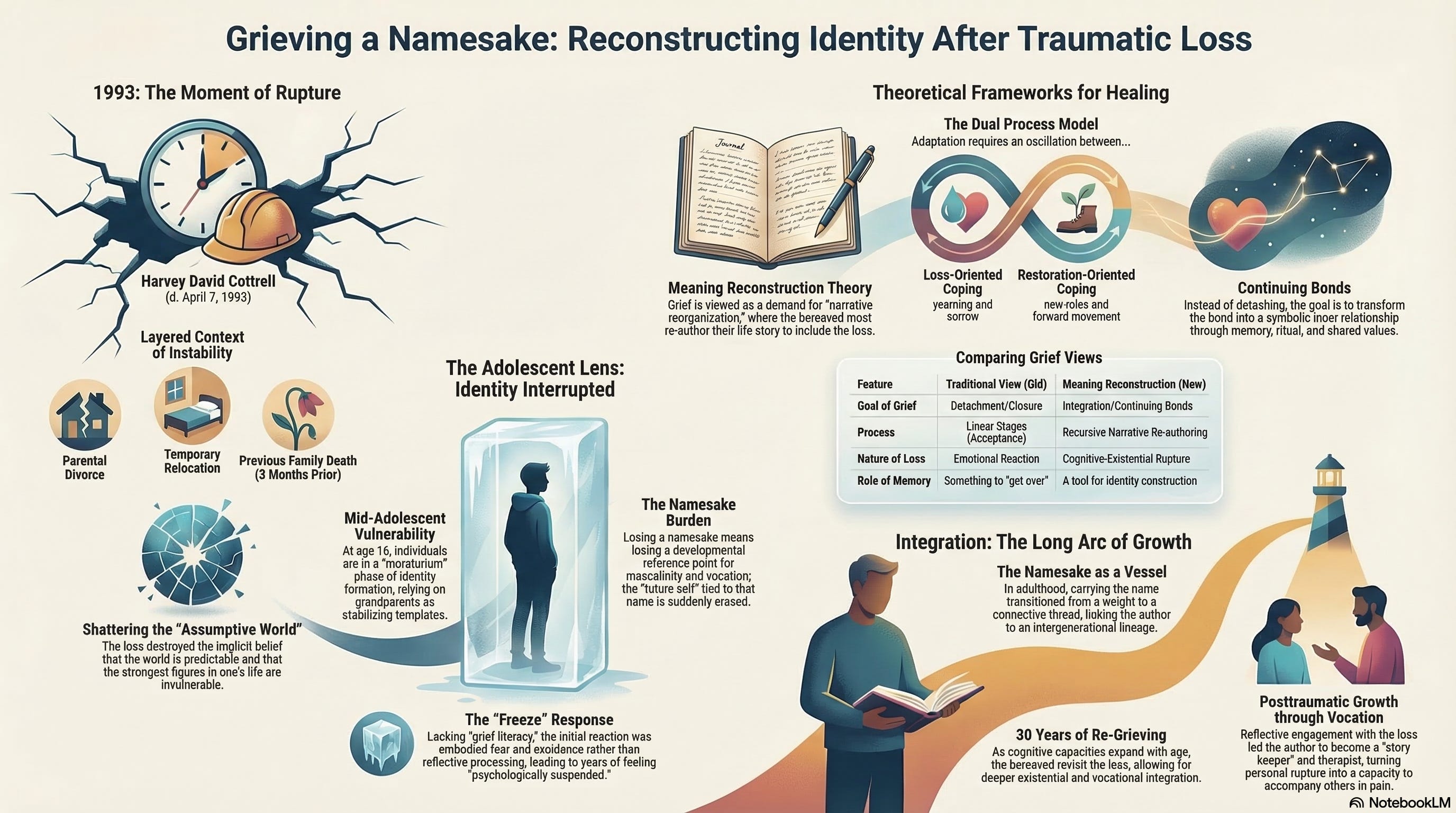
In a recent podcast, The Deep Dive discussed my paper, Grieving a Namesake: Identity, Legacy, and Meaning Reconstruction Following the Death of a Grandfather, which examines what happens when a young person loses not only a beloved grandfather, but the grandfather whose very name he carries. The paper argues that this kind of bereavement is not only a relational loss. It is an identity event, shaped by sudden traumatic death, adolescent development, family instability, and the lifelong work of meaning reconstruction.
My grandfather, Harvey David Cottrell, died in a workplace accident on April 7, 1993. I had turned sixteen eleven days earlier. At the time, I was living with my paternal grandparents after my parents’ divorce. My mother and siblings were temporarily living in a single bedroom at my aunt’s apartment, and earlier that same year my great-grandmother had also died. These were the first two deaths I had ever experienced, and they occurred within three months of one another.
That context matters because grief never enters a vacuum. Loss arrives inside a developmental stage, a family system, and an existing structure of stability or instability. In my case, the death of my grandfather did not interrupt a settled life. It came in the middle of rupture. The strongest adult male I knew, whose name I carried, was suddenly gone, and the world I had assumed to be stable no longer made sense.
One of the most important ideas discussed in the podcast is that contemporary grief theory no longer treats bereavement as something a person simply “gets over.” Meaning reconstruction theory understands grief as a crisis of meaning. When someone central to our lives dies, the assumptive world can shatter: the quiet, implicit beliefs that life is predictable, that relationships are secure, and that our personal story has continuity. Grief, from this perspective, is not only sadness. It is a cognitive and existential rupture that demands narrative reorganization.
That language is deeply resonant for me because it names what I lived before I had the words to describe it.
At sixteen, I had very little grief literacy. My first experience of loss was not organized around theory, reflection, or meaning. It was organized around sound, shock, fear, disorientation, and the sense that reality had split open. I heard my uncle tell my grandmother that my grandfather was dead. I heard her scream. I stayed in my room, unable to cross the threshold into the kitchen because doing so would make the event irreversibly real. Only later, with adult language and adult reflection, did the deeper meaning of the loss become available to me.
The paper argues that adolescence is a particularly important lens here. Identity at sixteen is still under construction. Adolescents rely on parents and grandparents not only for care, but as stabilizing figures and living templates for adulthood. My grandfather was not merely someone I loved. As both a primary male figure and my namesake, he functioned as a symbolic reference point for masculinity, continuity, and selfhood. His death removed not only a beloved person, but a developmental anchor.
That is what makes namesake grief especially complex.
To lose the person whose name you carry is to encounter grief in a uniquely identity-linked way. The loss is lodged not only in memory, but in the very structure of your self-introduction. The podcast captured this well: the shared name changes the paradigm of the loss. It is not simply that you remember the deceased. You continue to bear a daily symbolic bond with them in every signature, every document, every family story, every time your name is spoken aloud.
This is why older grief models built around detachment feel so inadequate. The idea that healing requires severing ties with the deceased does not hold up well in lived experience, and it especially fails in the case of a namesake. Contemporary grief scholarship offers a better framework in the language of continuing bonds. The task is not to end the relationship, but to revise it into a new form that can coexist with present life. For a namesake, the bond is not optional. The question is not whether the bond remains, but how it will be carried.
The podcast also explored the effect of sudden and traumatic death. Unlike anticipated loss, sudden death leaves no time for preparation. It intensifies shock, destabilizes the sense of safety, and forces an immediate confrontation with mortality. In my case, the strongest man I knew was crushed by the very machine he commanded. At sixteen, I could not cognitively reconcile that reality. The event shattered not only my sense of security, but my assumptions about strength, protection, and control.
For much of my adult life, I have described myself as feeling psychologically suspended between Good Friday and Easter. That phrase appears in the paper because it remains one of the most truthful descriptions I know for traumatic grief. You are no longer in the first moment of impact, yet you are not restored. You live in the long middle. The old world is gone, but the new one has not fully formed.
And yet the paper does not end in suspension.
Its central claim is that healing is not emotional erasure, detachment, or “closure.” Healing is the gradual work of reauthoring a life story that can hold both the reality of the loss and the ongoing need for meaning, purpose, and connection. Grief does not become morally acceptable. The tragedy does not become good. But the bereaved person can come to live in a world permanently altered by loss without remaining permanently disorganized by it.
In my own life, that has meant that grief eventually became one of the places where vocation was forged.
The podcast traced that trajectory with striking clarity. The frozen sixteen-year-old hiding in the bedroom did not remain the final version of the story. Over time, reflective engagement replaced avoidant coping. I gained new language, new tools, and new ways of revisiting the loss. I became a therapist, a trauma professional, a seminarian, and a family historian. None of those identities emerged separately from grief. They were, in many ways, part of the meaning reconstruction itself.
That may be one of the deepest truths in this whole project: grief can become not only what wounded us, but also what shaped our capacity to accompany others.
As the paper concludes, the loss of my grandfather did not simply mark a moment of devastation. It became part of the long formation of a life. It shaped how I understand trauma, legacy, ritual, and care. It taught me that mourning is not just about surviving absence. It is about learning how to carry forward love, identity, and memory in a changed form across the lifespan.
That is why this conversation matters to me.
In a recent podcast, The Deep Dive discussed my paper as a case study in grief, identity, and intergenerational meaning. But for me, this is more than theory. It is part of my own life story. It is part of how I have come to understand that some losses do not end. They evolve. They ask to be interpreted again and again as we grow, as our language deepens, and as our lives take shape around what once felt impossible to bear.
We do not heal by forgetting the dead.
We heal by learning how to carry them forward without losing ourselves.
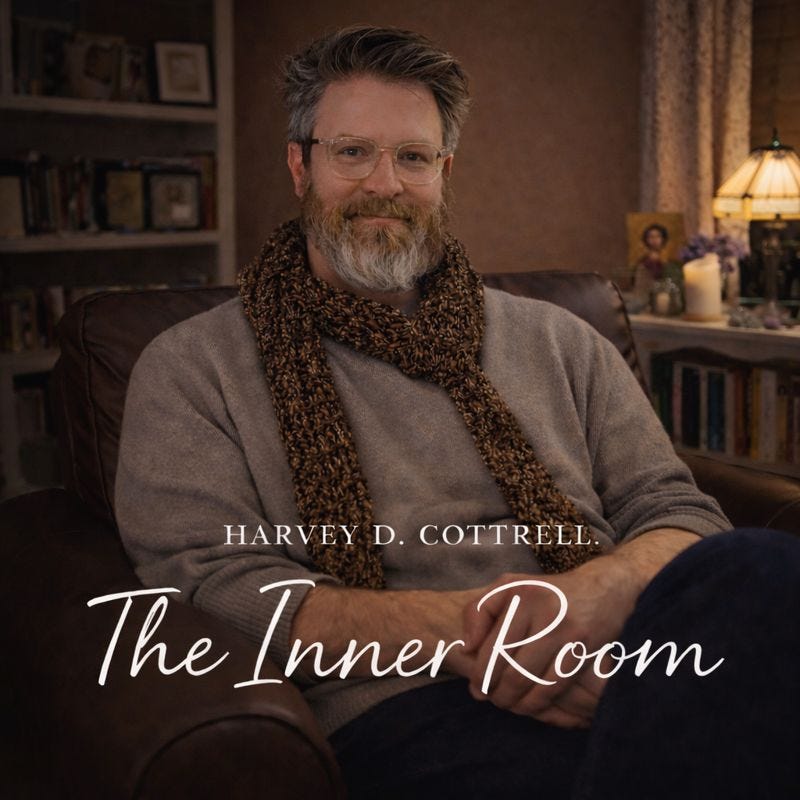
Harvey D. Cottrell, LCSW, earned both his Bachelor of Social Work (BSW) and Master of Social Work (MSW) from Monmouth University, with a clinical concentration in work with children and families and an emphasis on the neurobiological effects of trauma. He later deepened his focus on systems of protection and repair through a Master’s degree in Child Advocacy and Policy and a post-graduate certificate in Adolescent Advocacy from Montclair State University.
He is currently a PhD candidate (ABD) in Integrative Social Work at Saybrook University’s College of Integrative Medicine and Health Sciences, where his dissertation research investigates how politically salient family conflict relates to moral injury–related distress and multidimensional forgiveness, and how psychological flexibility and perceived belonging shape pathways of relational repair.


