
Staying Human When Conversations Are Hard
A three-part Inner Room series on speaking clearly, staying ethically intact, and relating without collapse or control.

Powerful communication does three things at once: it respects the other person’s dignity, releases you from responsibility for their reaction, and keeps you ethically intact. Ethical communication begins with the speaker’s orientation, not with control of the outcome.
George Bernard Shaw named a trap many of us fall into:
“The single biggest problem in communication is the illusion that it has taken place.”
Are you under a similar illusion?
Many people are not misunderstood because they lack clarity. They’re misunderstood because they mistake delivery for connection. They assume that because a message was spoken well-phrased, reasonable, even kind, it must have landed. But communication doesn’t complete itself at the moment of speech. It completes itself only when meaning is actually made.
The illusion shows up when:
We speak and move on without checking understanding.
We repeat ourselves louder instead of slower.
We interpret resistance as defiance rather than missed meaning.
We assume intent overrides impact.
Ethical communication asks more of us, not control over others, but humility about the limits of our words. It invites a pause long enough to wonder: Did I speak clearly, or did I just speak? And am I willing to learn what actually arrived, without defending the version I meant to send?
That question alone dissolves the illusion—and brings us back into the room.
There’s another trap that follows close behind: personalization.
How other people react is usually not about us. It reflects their internal context history, stress load, threat sensitivity, and the meaning they make in the moment. But we so often read their reaction as a message about our worth or safety, and we dysregulate. Then we communicate from urgency: over-explaining, fixing, arguing, often escalating the very thing we were trying to prevent.
So what do we do when the room gets hot, and our system starts sputtering?
We slow the moment down—on purpose. Not to control the other person, but to re-enter our own body and return to an ethical stance. Before we add more words, we check our orientation: What’s driving me right now—truth, or threat? This is where a simple framework helps. I use two: the Three A’s (Awareness, Authenticity, Audacity) and the Three Gates (Is it true? Is it necessary? Is it kind?). Together, they keep communication from turning into performance, and help us say what we mean cleanly without litigating it.
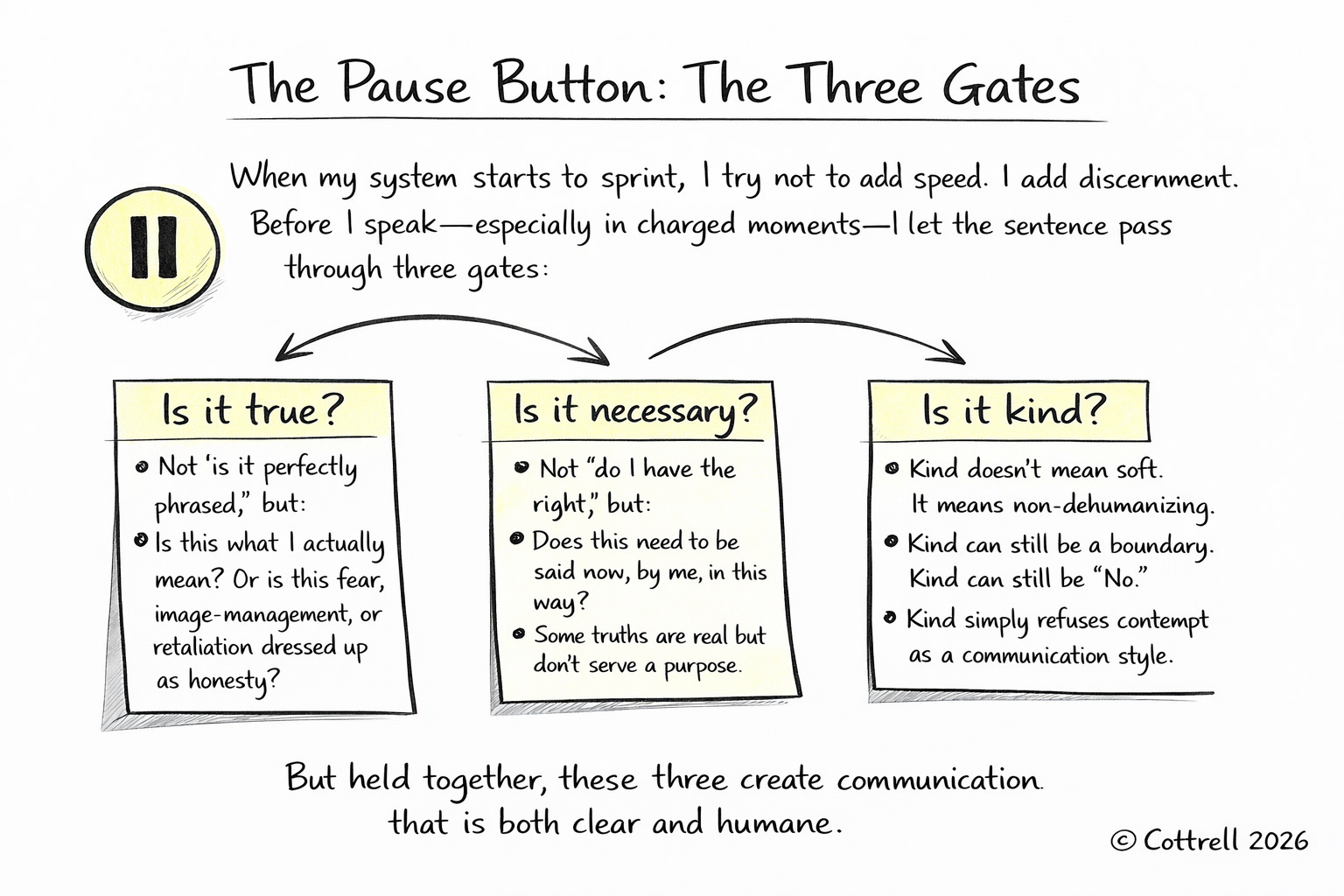
When my system starts to sprint, I try not to add speed. I add discernment. Before I speak—especially in charged moments—I let the sentence pass through three gates:
Is it true?
Not “is it perfectly phrased,” but: Is this what I actually mean? Or is this fear, image-management, or retaliation dressed up as honesty? Sometimes the truest words are the simplest: I don’t know yet. I can change my mind.
Is it necessary?
Not “do I have the right,” but: Does this need to be said now, by me, in this way? Some truths are real but poorly timed. Some truths are real but don’t serve a purpose. Necessity is where wisdom lives.
Is it kind?
Kind doesn’t mean soft. It means non-dehumanizing. Kind can still be a boundary. Kind can still be “No.” Kind simply refuses contempt as a communication style.
If it can’t pass these gates, it might still be true, but it isn’t ready to be spoken.
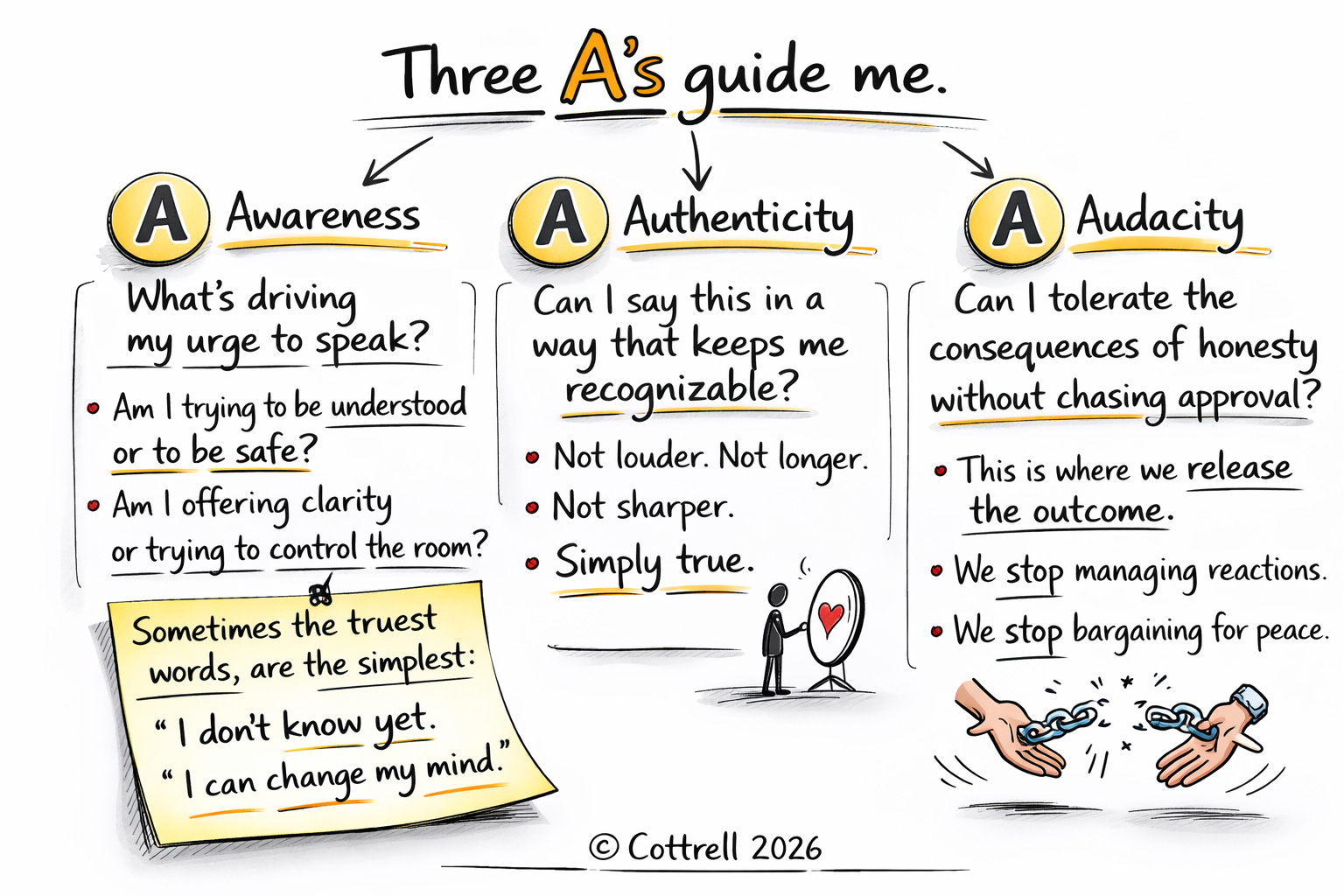
Once the sentence passes the gates, the question becomes: How do I deliver it without losing myself? This is where the Three A’s guide me.
Awareness: What’s driving my urge to speak?
Am I trying to be understood or to be safe? Am I offering clarity or trying to control the room?
Authenticity: Can I say this in a way that keeps me recognizable?
Not louder. Not longer. Not sharper. Simply true.
Audacity: Can I tolerate the consequences of honesty without chasing approval?
This is where we release the outcome. We stop managing reactions. We stop bargaining for peace.
And then—one last discipline:
Don’t litigate. Say what you mean and move on.
Over-explaining is often just anxiety reaching for a microphone. If the words are true, necessary, and kind, you can let them stand without a closing argument.
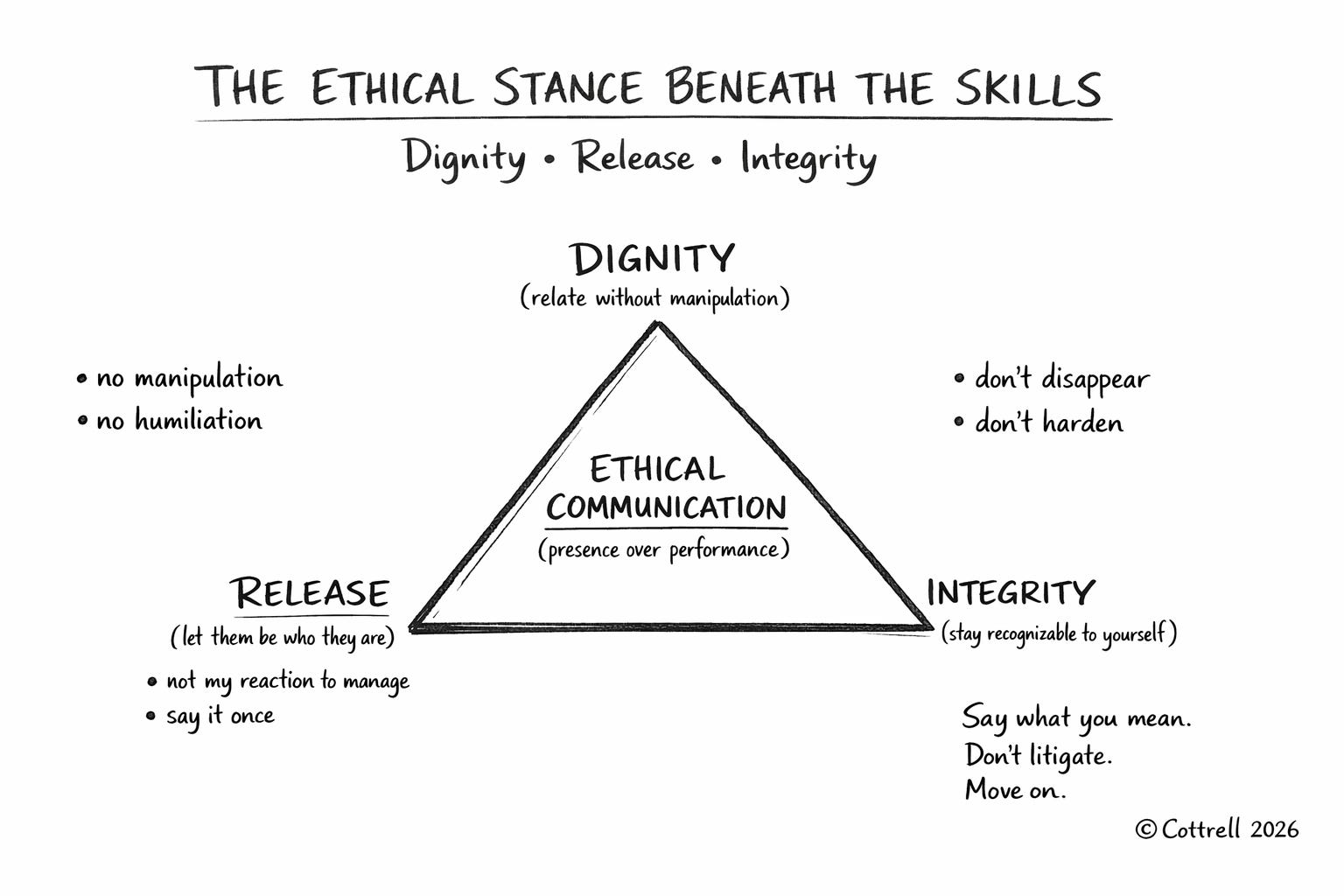
Techniques help. Frameworks slow us down. But underneath every communication skill is a deeper question:
Who am I choosing to be in this moment?
Powerful communication rests on three commitments not strategies, not tactics, but ethical orientations.
To communicate with dignity is to refuse to treat the other person as a problem to solve or a reaction to manage.
This is where manipulation often hides, not in cruelty, but in polish.
In phrasing designed to sound reasonable while steering the outcome.
In kindness that is really control.
Dignity says:
I will speak to you as a person, not as a variable.
It means listening without rehearsing.
Naming without humiliating.
Disagreeing without reducing.
Dignity does not require agreement.
It requires recognition.
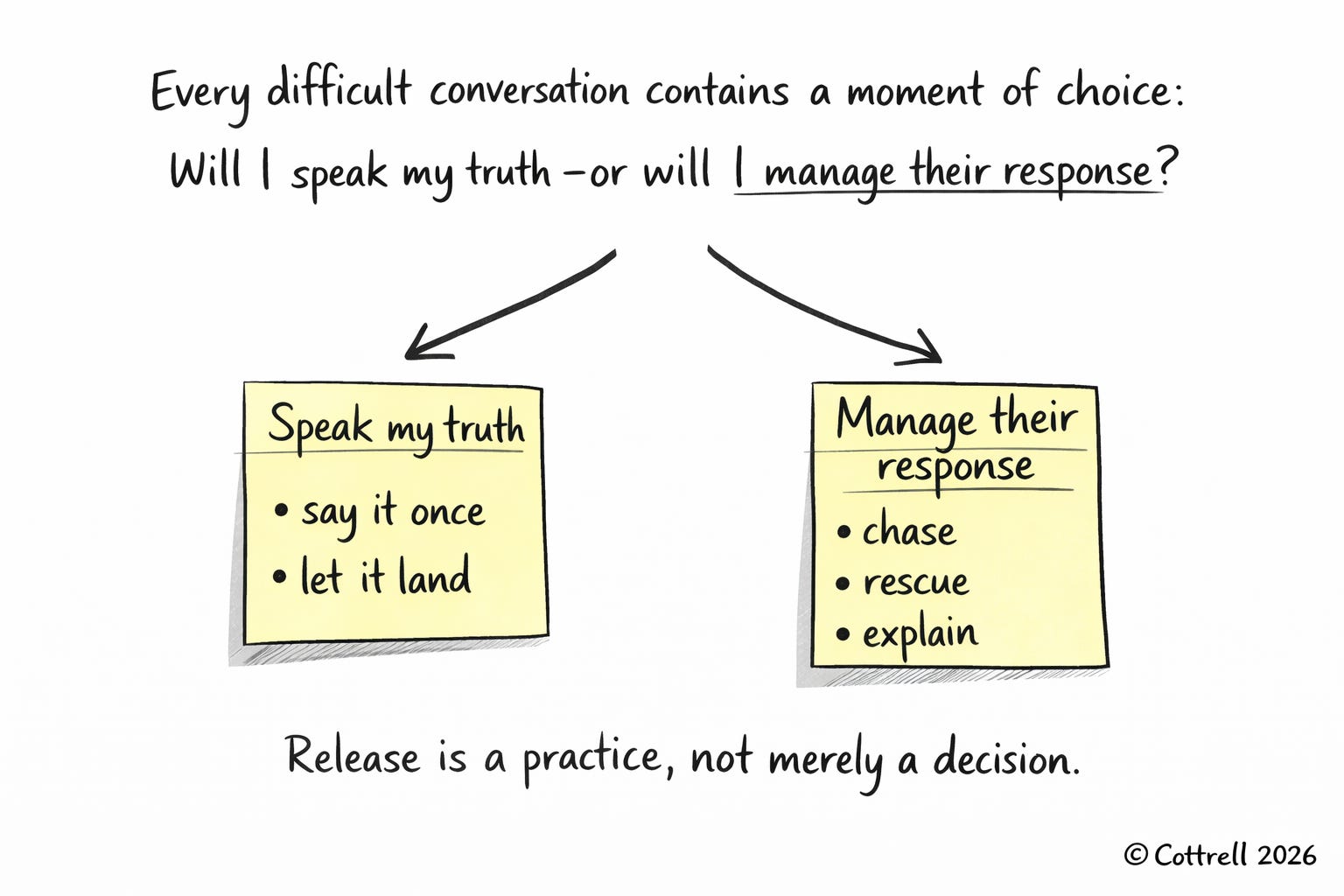
Every difficult conversation contains a moment of choice:
Will I speak my truth—or will I manage their response?
Release is the willingness to let others have their reactions without chasing them, fixing them, or defending against them.
This is not indifference.
It is ethical restraint.
Release sounds like:
saying the thing once
resisting the urge to clarify it into submission
allowing disappointment without rescuing
When we release the outcome, we stop confusing responsibility with control.
Other people are allowed to misunderstand you.
They are allowed to disagree.
They are allowed to show you who they are.
Integrity is not about being right.
It’s about being whole.
After the conversation ends, can you recognize yourself?
Did you stay present—or did you disappear, perform, or harden?
Integrity asks:
Did I say what was true for me without abandoning myself to keep the peace?
Sometimes integrity looks like speaking.
Sometimes it looks like restraint.
Sometimes it looks like leaving the conversation unfinished.
Integrity allows you to say:
This is where I am right now.
This is what I can offer.
This is where I need to stop.
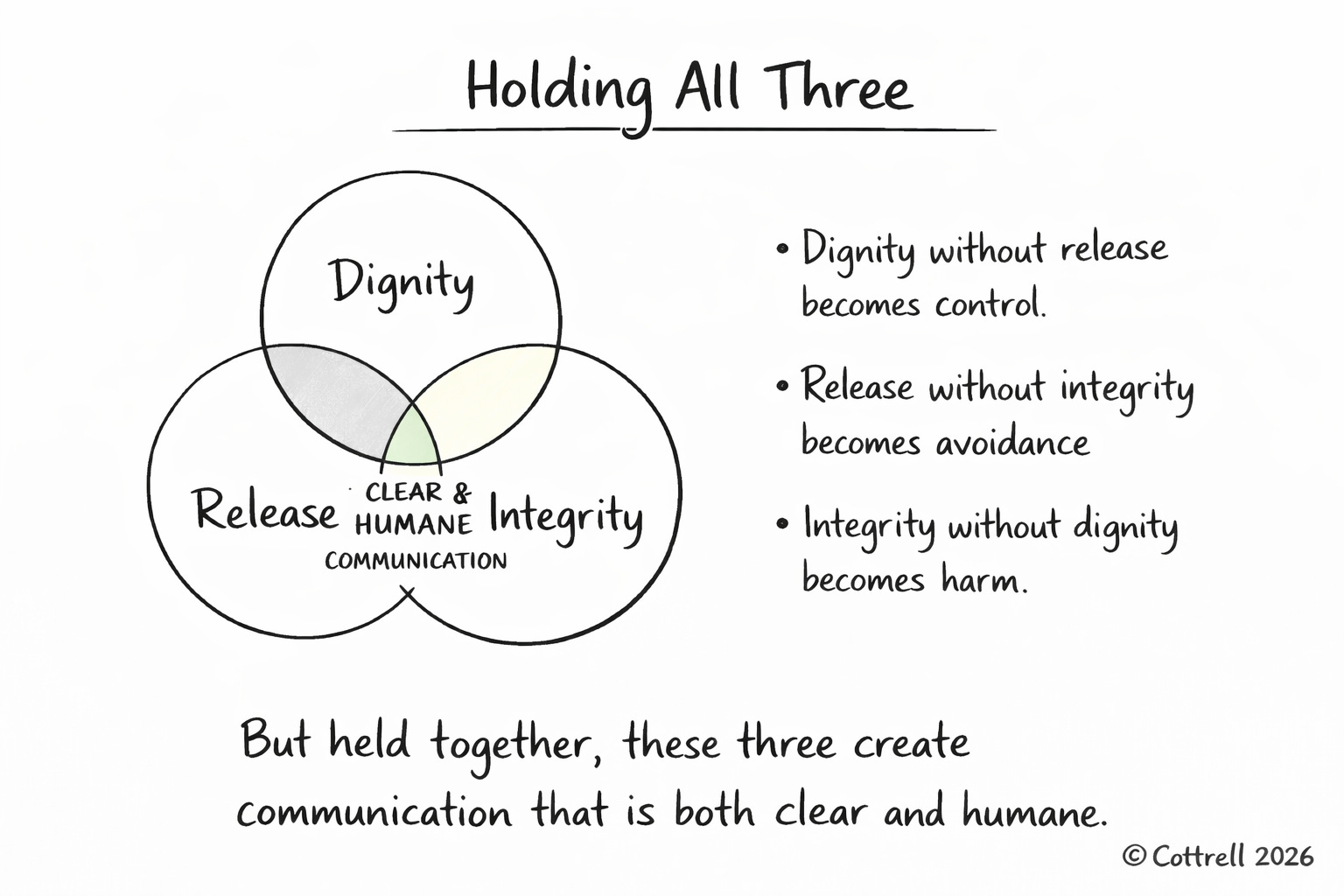
Dignity without release becomes control.
Release without integrity becomes avoidance.
Integrity without dignity becomes harm.
But held together, these three create communication that is both clear and humane.
They let you speak without manipulation, listen without collapse, and leave the conversation still yourself.
And that, perhaps, is the quiet power of ethical communication—not that it guarantees understanding, but that it allows you to remain human in the room.
Communication doesn’t fail because we lack words.
It fails because we forget who we are while using them.
When conversations get charged, the temptation is to perform: to manage reactions, secure agreement, or rush toward resolution. But ethical communication asks something quieter and braver. It asks us to stay oriented to dignity, to release, to integrity, even when the outcome is uncertain.
You can speak your truth without controlling how it lands.
You can listen without disappearing.
You can stop talking without abandoning the relationship.
Powerful communication is not measured by persuasion or peacekeeping, but by recognizability. When the conversation ends, are you still yourself? Did you relate without manipulation, let the other person be who they are, and leave the room ethically intact?
Sometimes the most faithful act is to say the thing once truthfully, necessarily, kindly, and then let it stand.
In Part II, we’ll go deeper into what makes that last step so difficult: how to release responsibility for other people’s reactions without becoming cold or detached, and how to stay in a relationship without carrying what was never yours to hold.
Read Part Two Here:
Part II: The Discipline of Letting People Have Their Response: Staying Human When Conversations Are Hard

In Part I, we explored what ethical communication requires before we speak: truth, necessity, and kindness.
I am fully present in my body, embracing the sensations that guide my emotions. In moments of stress, I choose to respond with mindfulness and compassion. I let go of emotions that no longer serve me, creating space for peace and joy. My thoughts are gentle companions, leading me back to the present moment. I recognize my distractions and take steps to minimize their impact, inviting clarity into my life. I cherish the connections I cultivate, nurturing my relationships with love and authenticity. I embrace forgiveness as a powerful tool for healing and growth, allowing love to flow freely within me and towards others. I transform my fears into motivation and honor my true self, expressing my unique strengths and passions. I practice radical acceptance, align my choices with my core values, and cultivate gratitude in all that I do. I am a beacon of love, compassion, and authenticity, leaving a positive legacy as I journey through life. Today and every day, I honor my true self and the beauty I bring to the world.

Harvey D. Cottrell, LCSW, earned both his Bachelor of Social Work (BSW) and Master of Social Work (MSW) from Monmouth University, with a clinical concentration in work with children and families and an emphasis on the neurobiological effects of trauma. He later deepened his focus on systems of protection and repair through a Master’s degree in Child Advocacy and Policy and a post-graduate certificate in Adolescent Advocacy from Montclair State University.
He is currently a PhD candidate (ABD) in Integrative Social Work at Saybrook University’s College of Integrative Medicine and Health Sciences, where his dissertation research investigates how politically salient family conflict relates to moral injury–related distress and multidimensional forgiveness, and how psychological flexibility and perceived belonging shape pathways of relational repair.
Revelation....I am astounded to see myself - will read again.
Thanks!