
Through the Looking Glass: The Algorithm that spins you right round dizzy.
When up is down and down is up in the attention economy


“Would you tell me, please, which way I ought to go from here?”
In Through the Looking-Glass, Alice asks this question while navigating a world that appears coherent on the surface but operates by an entirely different logic beneath the surface. The paths are offered confidently. The guidance sounds authoritative. And yet, the deeper problem isn’t choosing a direction; it’s realizing that the directions themselves can’t be trusted.

In our time, the algorithm answers Alice’s question all day long.
Not with a sentence you can debate, but with a sequence of offerings: Here—look at this. Now this. Now this. It feels like direction. It feels like orientation. It can even feel like discernment. But the guidance is not ordered toward truth. It is ordered toward attention.
That’s the inversion at the heart of the attention economy: a machine that cannot love you, cannot know you, and cannot tell the difference between care and contempt nonetheless becomes a kind of invisible compass. Many of us believe we are choosing the route—staying informed, tracking what matters, trying to respond ethically when in fact we are being directed: toward the emotions that keep us on the platform, toward the stories that hold us in place, toward the activation that makes us easiest to predict.
In The Divided Table, I kept naming the same distortion from different angles: this system doesn’t merely distribute information. It forms us. It trains the nervous system. It rehearses a posture of readiness. It quietly defines what “caring” looks like—then shames us when we can’t keep up.
The algorithm doesn’t need you to believe—it needs you to react
The algorithm is a prediction engine. It does not prioritize what is true; it prioritizes what will keep you there—scrolling, pausing, clicking, commenting, returning. Accuracy is not the currency. Engagement is.
That’s why anger and moral outrage rise to the top so reliably. Outrage is “sticky.” It’s hard to ignore. Pleasant content can be skipped. Nuance can be postponed. But perceived threat, humiliation, betrayal, or injustice demands an immediate response. Outrage narrows attention. It collapses complexity into an emergency. It makes you feel late—as if you don’t respond now, you’re complicit.
And the system learns your patterns with a cold intimacy: what makes you stop scrolling, what you watch to the end, what you replay, what you share “so others will know,” what you comment on “just to correct the record.”
Which leads to the cruelest trick: the machine cannot read intent.
If you watch a video because you love it, it registers: worked.
If you watch because it makes you furious, it registers: worked.
If you comment to correct a lie, it registers: worked.
If you quote-share to warn your community, it registers: worked.
It can’t tell the difference between engagement driven by love and engagement driven by contempt. It only knows that your attention was captured—and that capture is the product.
So we end up living inside a looking-glass economy where engagement feels like resistance, while often functioning like fuel.
What’s offered as endless information—limitless choice, limitless “freedom”—can become an albatross you don’t even notice you’re wearing. Not because you’re weak, but because it’s so normalized you forget it’s there.
And the weight isn’t only time. Its orientation.
The feed doesn’t just keep you busy; it can quietly anchor you to an idea—a storyline you begin to confuse with reality itself. You think you’re browsing. But you’re being moored: to a mood, to a tribe, to a posture of certainty. The algorithm hands you the comforting illusion of agency (“look at all these options”), while tightening the range of what feels thinkable, what feels safe, and what feels like “common sense.”
That’s how the albatross works: not as one dramatic chain you’d protest, but as a gentle, daily weight you forget to question until you realize you haven’t moved freely in a long time.
What makes the albatross so effective is that it isn’t mystical. It’s mechanical.
When we say “the algorithm,” we’re really talking about algorithms—plural. Interlocking systems of machine-learning models, each trained on massive datasets, each optimized for a narrow goal: maximize the probability that you will stay, react, and return.
They don’t know you in any human sense. They don’t need to. They work statistically.
Here’s how they “spin you like a top,” step by step.
1. Everything you do becomes training data
Every interaction that you pause on, how long you watch, whether you scroll back, what you like, comment on, share, save, or avoid becomes a signal. Even inaction is data. Scrolling past quickly tells the system something different than lingering for three seconds.
Over time, the system builds a behavioral profile, not of who you are, but of what reliably captures your attention. This profile includes:
Emotional triggers (what activates you)
Content formats (video, text, images, tone)
Timing patterns (when you’re most receptive)
Escalation thresholds (how intense content must be to hold you)
You are not categorized once. You are continuously updated.
2. Prediction, not persuasion, is the core task
The system is not asking, What should Harvey believe?
It’s asking, What is Harvey most likely to engage with next?
Machine-learning models generate thousands of probabilistic guesses per user per session. Each new piece of content is a test. Did you stop? Did you react? Did you stay longer?
When something “works,” it is reinforced. When it doesn’t, it’s discarded.
This is why feeds feel uncannily attuned and yet strangely flattening. The goal is not to expand you, it’s to reduce uncertainty about your behavior.
3. Emotional arousal becomes the strongest signal
From a data standpoint, emotionally neutral content is inefficient. Calm, nuanced material produces weaker signals: shorter watch times, fewer comments, slower feedback.
Anger, fear, disgust, and moral outrage produce clean data:
Longer engagement
Faster reactions
More comments
More shares
Stronger return probability
So the system learns—without malice, without intention—that activated nervous systems are profitable nervous systems.
Once that learning is encoded, the feed subtly escalates. Content doesn’t just match your views; it sharpens them. It becomes more emotionally charged over time, because heightened arousal keeps prediction accuracy high.
That’s the “spin.”
4. Feedback loops replace exploration
Early on, the feed may feel exploratory. Later, it becomes confirmatory.
Because the system optimizes for reliability, it gradually narrows the range of content it shows you. Ideas that reliably hold your attention are repeated in slightly different forms. Over time, this repetition produces familiarity, and familiarity produces felt truth.
This is how you end up anchored:
To a moral storyline
To a sense of who the villains are
To a perception of what is “obvious”
To a belief that your feed reflects reality rather than a slice of it
The spinning stops feeling like motion. It feels like ground.
5. The system confuses intensity with importance
One of the deepest distortions comes from a simple substitution:
What activates you begins to feel like what matters most.
Because the algorithm prioritizes what provokes a response, it trains your sense of salience. Issues that trigger strong emotion appear constantly; quieter realities disappear. This subtly reshapes your moral attention—not by argument, but by availability.
Over time, your inner compass is influenced less by reflection or values and more by what reliably produces arousal.
That’s not indoctrination in the old sense. It’s conditioning.
6. Why it feels like freedom while reducing it
From the inside, this process feels like a choice. You are clicking, selecting, reacting. The interface is full of options. But empirically, the system guides probability, not commands behavior.
You are free to move, but only within lanes that have been statistically optimized to keep you engaged.
That’s why the albatross is so hard to notice. It doesn’t yank you in one direction. It tilts the field until certain directions feel natural, urgent, and right—and others barely register as options at all.
And for the most part, this is how modern media works as well.
The difference is not kind, but in degree.
Traditional media—cable news, digital outlets, and even many legacy institutions now operate within the same attention-economy constraints. Revenue depends on clicks, views, watch time, subscriptions, and advertiser appeal. Which means the incentives increasingly converge: hold attention, provoke response, keep the audience coming back.
Editorial judgment hasn’t vanished, but it is no longer sovereign. It competes with analytics dashboards, A/B testing, real-time engagement metrics, and audience retention curves. Stories are selected, framed, and repeated not only because they matter, but because they perform.
And performance, empirically, favors the same things everywhere.
Conflict over context.
Speed over depth.
Certainty over ambiguity.
Emotion over explanation.
This is why headlines harden. Why panels polarize. Why “breaking news” rarely breaks open understanding. The system rewards stories that activate identity and threat perception because they elicit reliable attention.
Even when journalists are acting in good faith—even when reporting is factually accurate—the structure nudges content toward urgency and away from patience. Toward spectacle and away from repair.
The escalation problem
Once attention becomes the currency, escalation is almost inevitable.
What held attention last year won’t hold it this year. What once felt shocking becomes baseline. So tone intensifies. Language sharpens. Stakes inflate. Every issue is framed as existential. Every disagreement becomes a crisis. Every cycle must outpace the last.
This doesn’t require a conspiracy. It emerges naturally from feedback loops.
Audiences respond more intensely to conflict.
Metrics confirm conflict performs.
Conflict becomes central.
Calm analysis feels flat by comparison.
Over time, the media doesn’t just report polarization—it participates in it, because polarization is legible, clickable, and narratively efficient.
And just like with algorithmic feeds, repetition does its quiet work. The same frames, the same villains, the same moral scripts appear again and again until they begin to feel like reality itself.
Why does this feel informative but leave us disoriented?
One of the strangest outcomes of this system is that people can consume enormous amounts of news and still feel less oriented, not more.
That’s because information alone doesn’t create understanding. Understanding requires context, proportion, historical memory, and the ability to tolerate uncertainty. Those are slow processes. They don’t spike engagement. They don’t lend themselves to constant updates.
So instead, we get saturation without integration.
We know what to be outraged about today.
We are less clear about what to do with that outrage tomorrow.
And even less clear about how to live with one another after the cycle moves on.
The result is a public that feels informed but chronically unsettled—alert, reactive, and oddly powerless. Much like the algorithmic feed, modern media can leave the nervous system activated while offering little help in metabolizing what it delivers.
The convergence
This is the deeper problem: social media algorithms and modern media are no longer separate systems. They feed each other.
Media content is optimized to travel well on platforms.
Platforms reward media that travel fast and provoke a reaction.
Both learn from the same engagement data.
So the line between “the feed” and “the news” blurs. What trends become newsworthy? What is newsworthy trends harder. And the public sphere begins to run on the same nervous-system dynamics everywhere.
The albatross gets heavier—not because one source is lying, but because the entire ecosystem tilts toward activation.
Information, formation, deformation
In this ecosystem, the question is no longer simply, Is this true?
It’s also: What is this doing to me? And then, ethically: What is this making me more likely to do to other people?
That’s where the distinction matters:
Information is content that increases accuracy. It adds context, proportion, and verifiable detail. It can be unsettling, but it tends to leave you more capable of thinking, not less. Information expands your map.
Formation is what happens when repeated inputs shape your attention, your reflexes, and your moral imagination over time. Formation trains what you notice, what you dismiss, what you consider “normal,” and what you treat as urgent. Formation isn’t only about beliefs—it’s about posture: who you expect to be dangerous, what you assume is obvious, how quickly you move to judgment.
Deformation is a formation that bends you away from dignity. It narrows empathy, reduces complexity, and rewards contempt. It trains the nervous system to live in a state of bracing, the mind to live fused, and the conscience to confuse intensity with importance. Deformation doesn’t just make you misinformed—it makes you less free: less able to choose your responses, less able to see a whole human being, less able to tolerate nuance without feeling threatened.
Here’s the ethical test I keep returning to:
Information increases my capacity for truth.
Formation increases my capacity for wise action.
Deformation increases my capacity for harm—often while convincing me I’m being virtuous.
And that last one is why this matters. The most dangerous content isn’t always factually false. Sometimes it’s content that is factually adjacent—technically “true enough” but delivered in a way that trains contempt, accelerates certainty, and erodes our ability to practice dignity in real relationships.
In other words, the question isn’t only whether the feed is lying.
It’s whether the feed is shaping you into someone you recognize—someone capable of repair.
This is why, whether a claim is true or not, a phrase like “fake news” is so corrosive. It doesn’t simply challenge accuracy; it upends trust itself. Once trust collapses, the question shifts from What is true? to Who do I believe?—and eventually to Is anything reliable at all? In that vacuum, orientation fails. We become easier to disorient, easier to spin, easier to exhaust.
This is the logic of what I would call the era of chaos politics: not the steady persuasion of ideology, but the deliberate production of instability. The news begins to feel like whiplash—one emergency replacing another before meaning can settle. Facts are shouted, contradicted, reframed, discredited, and re-shouted until discernment gives way to fatigue. It’s less like public deliberation and more like a twisted game of apocalypse bingo, where every square is catastrophic and nothing ever quite resolves.
And that exhaustion is not incidental. A disoriented public is a pliable one. When the ground won’t hold, people reach for certainty, for tribes, for strong emotion, anything that offers the relief of orientation, even if that orientation is illusory. In that sense, chaos doesn’t just undermine truth; it accelerates deformation, training us to live without shared reality while mistaking constant alarm for moral seriousness.
Why is this especially dangerous for children, families, and communities?
This kind of disorientation is damaging for everyone. But it is especially dangerous for children, families, and the social fabric that holds communities together because these are the places where orientation is learned, not just chosen.
For children, the danger is formative. Children learn how the world works by watching how adults relate to reality, conflict, and one another. When the information environment is chaotic, when truth feels unstable, authority feels suspect, and outrage is constant, children don’t just absorb facts. They absorb posture.
They learn:
that urgency is normal,
that contempt is an acceptable way to respond to difference,
that attention belongs to whoever is loudest or angriest,
that fear is a reasonable baseline.
A nervous system that is constantly activated has fewer opportunities to develop regulation, curiosity, and trust. Over time, this can shape how children relate to authority, difference, and even their own inner lives. The cost isn’t just confusion; it’s reduced capacity for steadiness.
For families, the danger is relational. Families rely on shared reality to function: shared assumptions about what matters, shared narratives about safety and care, shared ways of resolving disagreement. Chaos, politics, and algorithmic activation fracture that commons.
When each family member is being fed a different emotional universe—different threats, different villains, different urgencies—the household becomes a site of ambient tension. Conversations feel brittle. Misunderstandings escalate quickly. Silence starts to feel safer than speech. Repair becomes harder because people are reacting not only to one another but also to unseen forces that shape their interpretations in the background.
What’s lost is not agreement, but mutual intelligibility, the sense that even when we disagree, we are still speaking the same language of reality.
For communities, the danger is structural. Communities depend on trust, proportion, and the ability to tolerate difference without immediate rupture. When outrage becomes the primary signal of importance, local realities are crowded out by distant emergencies. Attention is pulled upward and outward—toward spectacle—while the slow work of care nearby goes unnoticed.
This weakens the habits that sustain communal life:
listening without immediate judgment,
disagreement without dehumanization,
accountability without annihilation,
repair without performance.
In a constantly activated environment, people don’t just become polarized—they become exhausted. And exhausted communities are easier to divide, easier to manipulate, and less capable of collective care.
The Greatest Risk
The greatest danger isn’t that people believe false things.
It’s that they lose the capacity to be oriented together.
When shared reality erodes, children inherit anxiety instead of grounding, families inherit silence instead of repair, and communities inherit suspicion instead of solidarity. In that vacuum, the loudest voices and the strongest emotions gain disproportionate power—not because they are wise, but because they offer relief from disorientation.
That’s why this isn’t merely a media problem. It’s a moral and relational one.
And why the work of resistance—slowing down, regulating, choosing dignity over activation, protecting shared reality in small, human-scale ways—is not optional. It’s how we safeguard the conditions under which children can grow, families can speak, and communities can remain communities at all.
What can we do?
There’s a moment many people describe now—not in clinical language, just in lived language—when they say something like: “I don’t even know why I’m so tense. I’m just scrolling.”
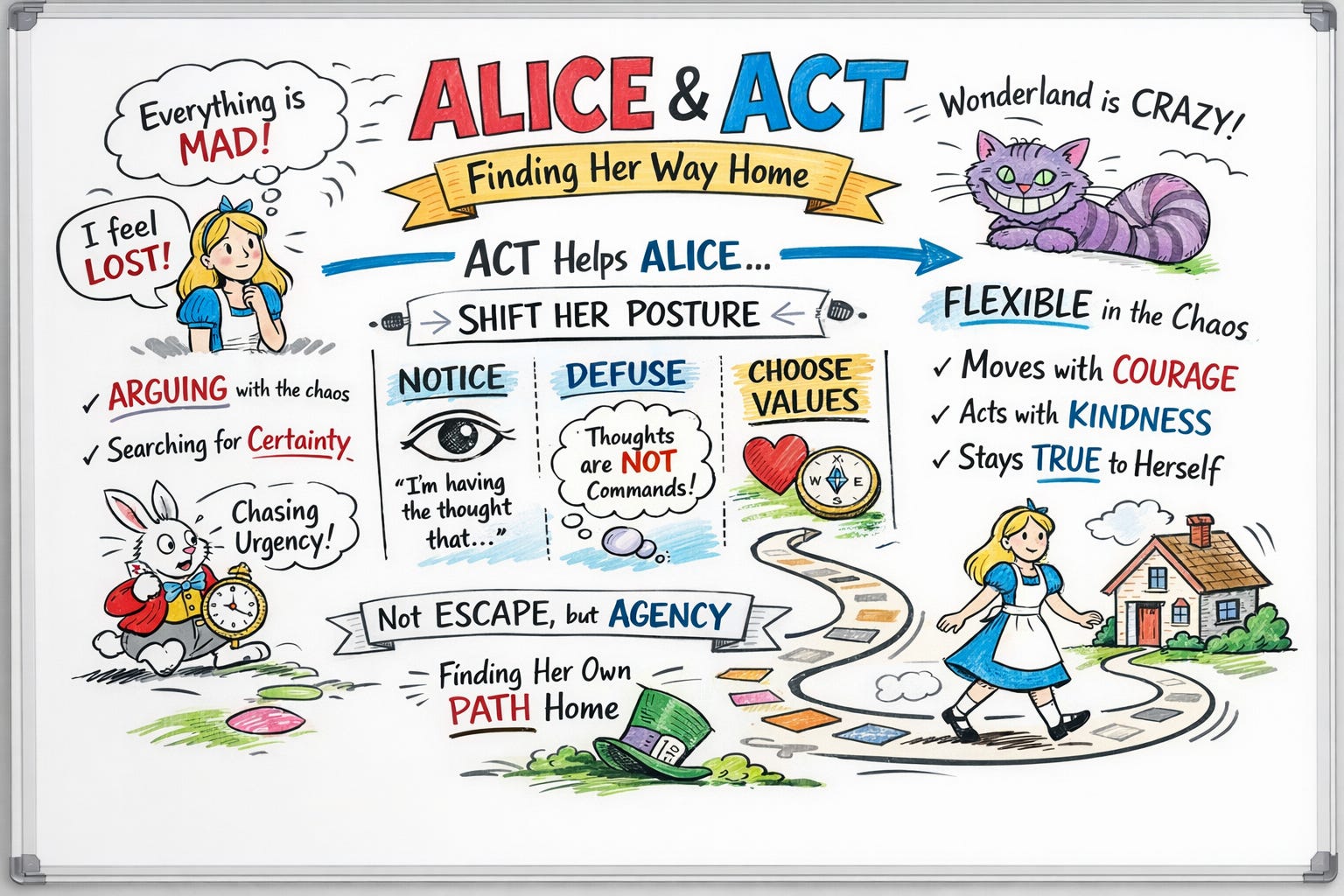
That’s often where Acceptance and Commitment Therapy (ACT) begins.
ACT is a form of therapy that focuses less on controlling thoughts or emotions and more on changing our relationship to them. Instead of asking, How do I get rid of this feeling? ACT asks, Can I notice what’s here, make room for it, and still choose how I want to live? At its core, ACT is about psychological flexibility: the capacity to stay present, even when things are uncomfortable, and to act in alignment with what matters most.
In the attention economy, that orientation is quietly radical.
ACT doesn’t start by arguing with the content of the feed. It doesn’t begin with fact-checking or moral positioning. It begins with the body. A clenched jaw. A shallow breath. A tight chest. ACT treats these not as failures of discipline, but as signals evidence that your nervous system is responding to a world that keeps pulling the fire alarm.
Instead of saying, “Calm down,” ACT says, “Notice.”
Notice that your mind is producing a story.
Notice that your body is bracing.
Notice the urge to react, correct, or escalate.
And then ACT introduces a small but powerful shift: space.
One of ACT’s central practices is called defusion—learning to see thoughts as thoughts, not commands. In an algorithmically activated world, this matters enormously. When the feed insists, This is outrageous. This is dangerous. You must respond. ACT helps you say, I’m having the thought that this is outrageous. The thought doesn’t vanish, but its grip loosens. You recover a bit of distance. Choice becomes possible again.
From there, ACT does something the algorithm cannot tolerate: it slows the moment down.
ACT doesn’t ask, What should I post?
It asks, What kind of person do I want to be right now?
This is where values come in—not values as slogans or positions, but values as orientation. Dignity. Care. Honesty. Courage. Repair. Values don’t tell you what opinion to hold. They tell you how to move when certainty is unavailable.
Sometimes acting on values means engaging thoughtfully.
Sometimes it means researching slowly instead of reacting quickly.
Sometimes it means stepping away and letting that be a moral choice rather than a failure. Sometimes it means choosing a real conversation over a public performance.
ACT is especially suited to this moment because it doesn’t promise relief through certainty. It builds capacity.
The capacity to feel anger without becoming cruel. Capacity to feel fear without letting it shrink your world. Capacity to stay present without being recruited into every manufactured emergency.
In families, this looks like adults who can pause rather than escalate—who name what’s happening inside rather than weaponizing it outside. In communities, it looks like choosing repair over righteousness, curiosity over contempt. For children, it looks like something quietly essential: caregivers whose nervous systems don’t abandon them when things get intense.
ACT doesn’t save us from chaos. It helps us not become chaotic ourselves.
And in a world that profits from our disorientation, that may be one of the most ethical acts available to us: staying present, choosing our values, and acting in ways that preserve dignity one regulated nervous system at a time.

If you read Alice closely, what finally helps her find her way home isn’t better directions. It’s a change in how she relates to the chaos around her.
At first, Alice does what any reasonable person would do in an unreasonable world: she argues with it. She tries to apply logic where logic no longer holds. She takes every rule literally, every demand seriously, every absurdity personally. And the more she tries to master Wonderland, the more disoriented she becomes.
This is where Acceptance and Commitment Therapy quietly mirrors her journey.
ACT would say that Alice’s early struggle isn’t that Wonderland is confusing; it’s that she keeps trying to make it stop being confusing. She wants certainty before movement. She wants rules before action. She wants reassurance before a choice.
But Wonderland doesn’t offer that. Neither does the attention economy.
What changes for Alice is not that the world becomes clearer, but that she becomes more flexible inside it.
She begins to notice instead of arguing. She pauses instead of panics. She grows curious about what’s happening in her as much as what’s happening around her.
In ACT terms, Alice learns acceptance, not approval, not passivity, but the willingness to stop fighting reality long enough to see it clearly. She stops insisting that things feel sensible before she moves. She allows the discomfort of not knowing where she is without collapsing into it.
She also learns defusion. The declarations of Wonderland—You don’t belong here, This is madness, You must do this now—lose some of their power over her. She hears them, but she no longer treats them as unquestionable commands. They become voices in the room, not the law of the land.
And crucially, Alice begins to act from values, even when the world remains absurd.
She chooses honesty over performance.
Curiosity over contempt.
Courage over compliance.
She doesn’t wait for the Queen to become reasonable before she refuses to be cruel. She doesn’t need the rules to make sense before she decides who she will be. This is ACT at its heart: choosing how to live with uncertainty instead of demanding that uncertainty resolve itself first.
By the end, Alice hasn’t solved Wonderland. She hasn’t fixed it. She hasn’t mapped it.
She’s simply no longer ruled by it.
That’s how she finds her way home.
Not by escaping chaos, but by no longer letting chaos dictate her inner posture. Not by silencing every confusing voice, but by recovering the ability to choose which ones deserve her attention.
ACT doesn’t give Alice a map.
It gives her back her agency.
And in a world—ours included—that constantly tells us which way to go, that may be the truest way home there is.
So what do we do with the dizziness?
If the algorithm has spun us until direction feels unreliable, the answer is not to spin faster. You don’t cure vertigo by running. You stop. You widen your stance. You let your inner ear recalibrate.
The dizziness many of us feel right now is not personal failure. It’s a directional injury. A nervous system asked to track too many urgencies, too many threats, too many “which way should I go?” questions at once—without any stable horizon.
So the work is not to find the right direction in the feed.
It’s to recover orientation outside it.
ACT offers a deceptively simple starting point: come back to where you are.
Feel your feet.
Unclench the jaw.
Lengthen the breath.
Name the weather in your body.
This is not retreat. It’s recalibration. You cannot choose wisely while dizzy.
From there, choose values over velocity. Values don’t tell you what to think about every issue. They tell you how you want to move when clarity is incomplete. Dignity. Care. Truthfulness. Restraint. Repair. These become your compass when the map won’t hold.
Then, make your world smaller and more human.
Read slower. Fewer sources. Longer pieces.
Talk to actual people, in real rooms, with real stakes.
Let some crises pass without your commentary.
Protect shared reality where you can—especially with children—by modeling steadiness rather than spectacle.
You don’t need to exit the world to do this. You need to stop letting a profit-driven system set the tempo of your conscience.
Alice doesn’t find her way home by mastering Wonderland. She finds it by no longer letting Wonderland master her. She stops chasing every demand. She stops arguing with every absurd rule. She recovers the ability to choose who she will be, even when the world remains strange.
That’s the invitation here.
When direction is unreliable, choose presence.
When certainty is weaponized, choose humility.
When outrage is rewarded, choose dignity.
When the ground keeps shifting, choose to stand still long enough to remember who you are.
You don’t have to know exactly where you’re going.
You just have to stop letting the algorithm decide how you walk.
And that—quietly, stubbornly—is how you find your way home.
What happens next isn’t just epistemological. It’s relational. When entire systems train us to confuse certainty with truth, those habits don’t stay online — they come home with us, into families, friendships, and moral life. I explored that human cost in a three-part series on moral injury and repair in politically charged family relationships. The series begins here: Part I — When Politics Fractures Family Belonging.

I am fully present in my body, embracing the sensations that guide my emotions. In moments of stress, I choose to respond with mindfulness and compassion. I let go of emotions that no longer serve me, creating space for peace and joy. My thoughts are gentle companions, leading me back to the present moment. I recognize my distractions and take steps to minimize their impact, inviting clarity into my life. I cherish the connections I cultivate, nurturing my relationships with love and authenticity. I embrace forgiveness as a powerful tool for healing and growth, allowing love to flow freely within me and towards others. I transform my fears into motivation and honor my true self, expressing my unique strengths and passions. I practice radical acceptance, align my choices with my core values, and cultivate gratitude in all that I do. I am a beacon of love, compassion, and authenticity, leaving a positive legacy as I journey through life. Today and every day, I honor my true self and the beauty I bring to the world.
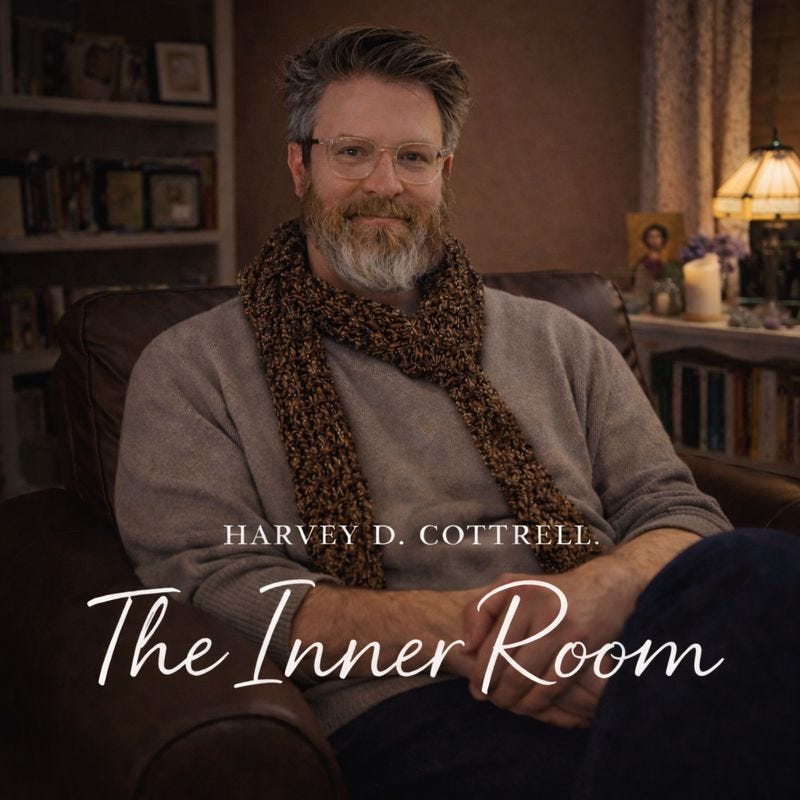
Harvey D. Cottrell, LCSW, earned both his Bachelor of Social Work (BSW) and Master of Social Work (MSW) from Monmouth University, with a clinical concentration in work with children and families and an emphasis on the neurobiological effects of trauma. He later deepened his focus on systems of protection and repair through a Master’s degree in Child Advocacy and Policy and a post-graduate certificate in Adolescent Advocacy from Montclair State University.
He is currently a PhD candidate (ABD) in Integrative Social Work at Saybrook University’s College of Integrative Medicine and Health Sciences, where his research explores forgiveness, reintegration, and resilience among individuals wounded by trauma.