
Standing in Doorways: Learning to Trust Yourself
A Weekly Examen on Boundaries, Grief, and Quiet Courage | The Inner Room

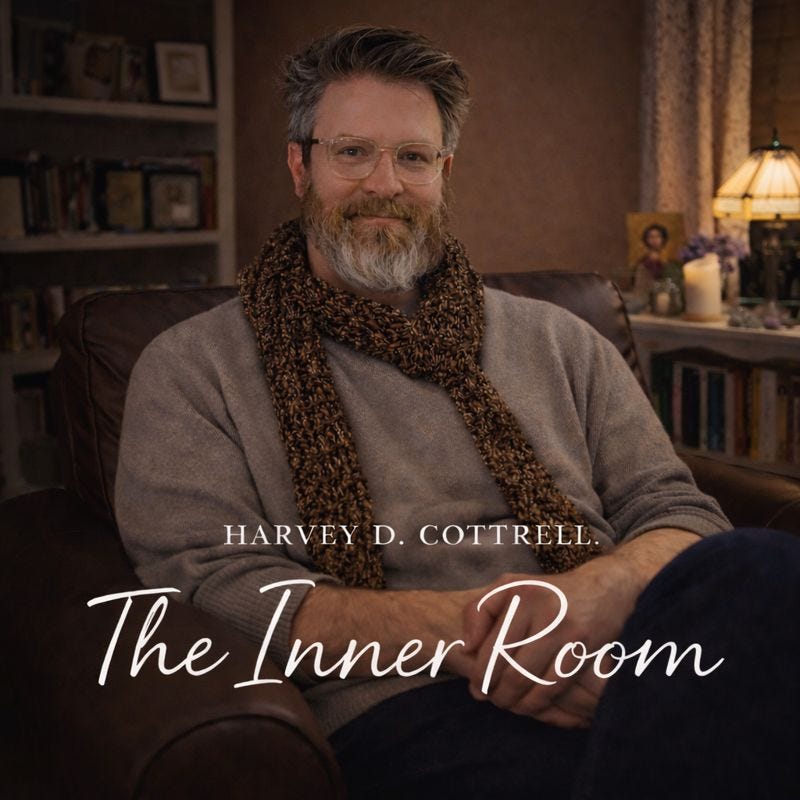
The Inner Room is the place beneath performance and explanation, where you are no longer required to justify your pain or prove your worth. It is where the body is allowed to speak, where grief can be named without being rushed, where anger can be held without becoming violence, and where forgiveness, when it comes, begins as truth, not erasure. The Inner Room is a refuge. A place to lay down what was never meant to be carried alone, to listen for what is still alive in you, and to remember that staying human is not weakness, but a sacred form of strength.
How to Read This Weekly Examen
This is not a lesson. It’s not a self-improvement plan. It’s not a list of things you should be doing. Think of this as a candle lit at the end of the week, an offering of quiet companionship. Each Friday (or at week’s end), I gather the themes that surfaced across the week’s sessions. Not names, not details, never anything that could identify a person, only the emotional weather: the repeating questions, the shared patterns, the places where courage showed up softly, and where silence carried more truth than words. What you’re reading is a kind of reverent distillation, meant to hold you in a wider human context without ever exposing anyone’s story.
You’ll notice a few parts. First, a short reflection written to be read slowly, like a prayer rather than information. Then a weekly quote to carry. Then the Ten Words language I’m using to name what kept returning across real lives. Then the questions beneath the week, because often we don’t need answers as much as we need permission to admit what we’re asking. You may also see a brief synthesis that gathers the week into one thread, and a closing section—I See You—because the point of this space is not to fix you, but to remind you that you are not invisible. Finally, there’s a gentle practice (the Helix Practice): a short, embodied way to process the week if you want something to do besides think.
Here’s how I invite you to engage: don’t try to take in every line. Let one paragraph find you. Let one sentence land. If something stirs tenderness or resistance, that’s information no need to argue with it. If a theme doesn’t fit your life this week, let it pass without forcing meaning. And if you are tired, you can simply receive this as companionship: a reminder that you are part of a silent community of people trying to live honestly, set boundaries without violence, grieve without rushing, listen to their bodies without panic, and take one small step forward even when certainty won’t come.
Every evening, after sessions end and the screens go dark, I sit quietly with the stories I’ve been entrusted to hold, not names, not details, never anything that could identify a person, but the themes that move through different lives like shared weather. I listen for the emotional undercurrents, the questions that keep repeating, the places where courage shows up unexpectedly, and where silence carries more truth than words. This is not data or diagnosis; it is reverence. At the end of each week, I gather what I’ve heard, not who said it, but what the human heart was doing beneath it all, and I lay those patterns down like stones, asking what kept returning, what kept echoing across different lives. This reflection is my way of holding you together in silent community. You will never know one another. You might pass each other in a grocery store, sit in the same coffee shop, stand in the same line at the pharmacy, and never know how your stories quietly intersect, how your grief rhymes, how your courage mirrors someone else’s, how your questions are being asked in ten different homes. But I see it, and I hold it with sacred, tender compassion. This is not advice or instruction; it is an invitation to remember that even in your most private battles, the ones no one applauds and the ones you carry alone at night, you are not alone. This is ordinary human life, and it is also extraordinary. Welcome to The Inner Room.
Standing in a doorway/transition
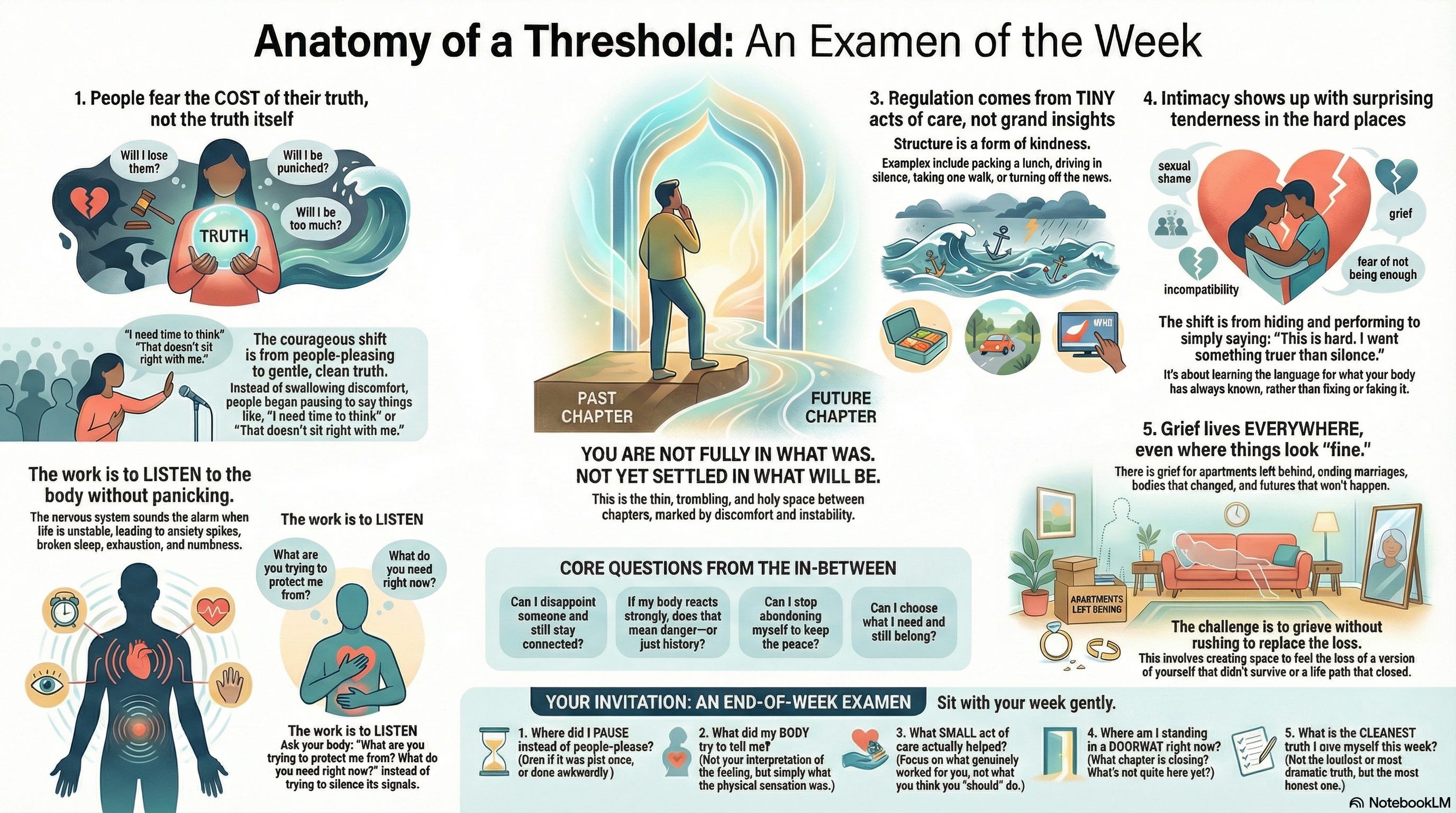
This week feels like standing on a threshold, one hand still on the old doorframe, the other reaching for something you can’t fully see yet. Not everything is broken, but not everything fits anymore either. It’s the ache of becoming. The quiet bravery of not rushing to name what’s next. Doorways are tender places. They ask us to pause. To notice who we’ve been. To honor what carried us here. And to trust that even if the next room is unfamiliar, we are allowed to step when we’re ready, not when we’re pressured.
Listening to my body
Your body has been speaking, maybe louder than usual. In fatigue. In restlessness. In tears that come without explanation. In numbness that feels confusing. This isn’t betrayal. It’s communication. The body remembers what the mind tries to reason away. When you listen without judgment, when you place a hand on your chest instead of reaching for answers, you begin to hear what you actually need. Not what you should need. But what is true right now?
Setting gentle boundaries
A new language is growing within you. Softer. Cleaner. Less apologetic. You’re learning to say, “I need time.” “That doesn’t work for me.” “I’m not sure yet.” These aren’t walls. They’re doorways too. Boundaries don’t mean you love less. They mean you’re finally including yourself in the room. This is not rejection. This is respect.
Grief or letting go
Some of you are grieving things that aren’t gone yet. A relationship changing shape. A home that won’t be yours much longer. A version of yourself you’re quietly outgrowing. Grief doesn’t always arrive with ceremonies. Sometimes it arrives as nostalgia for the present moment. As tenderness for what still exists. Let yourself mourn without rushing to replace. Let grief be love with nowhere to go for a while.
Taking one small step forward
You don’t have to fix your whole life. You only have to choose one small thing today. Drink water. Send the email. Step outside. Breathe before you answer. Small steps are not insignificant; they are how trust is rebuilt. This is how agency returns. Not all at once. But inch by inch. Choice by choice.
I’m not sure yet
There is holiness in not knowing. In refusing to pretend certainty. “I’m not sure yet” is an honest prayer. It means you are listening. It means you are learning to trust yourself instead of forcing a conclusion. You are allowed to live inside the question. You are allowed to change your mind. You are allowed to take your time.
And in all of this, you are not alone.
This Week’s Quote
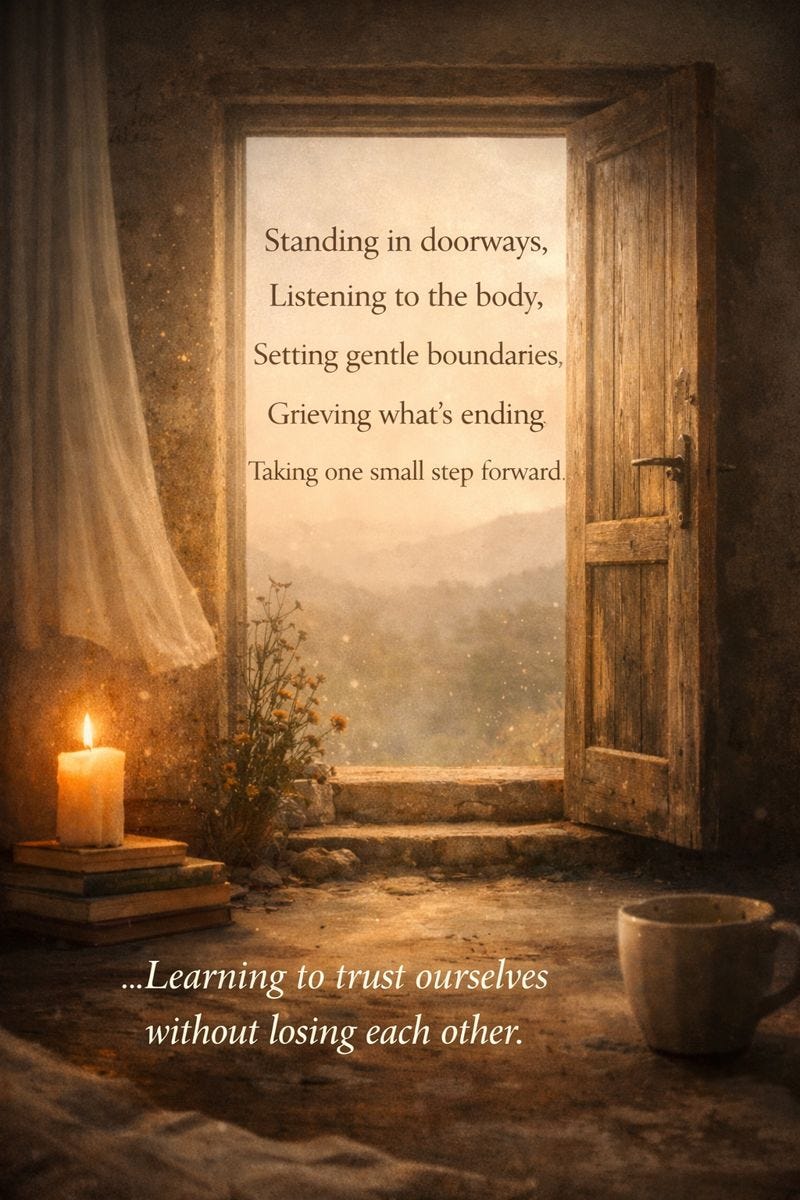
“We are standing in doorways this week learning to trust the body’s messages without obeying every alarm, choosing one small act of courage over grand certainty,
turning shame into language, grief into movement, and boundaries into quiet forms of love. We are discovering that structure can be mercy, planning can be prayer,
and choosing ourselves does not mean abandoning anyone else. This is how we learn to live the questions not loudly, but faithfully.”
Ten Words for This Week
(These are the week’s words, drawn from the themes that kept repeating across real lives.)
Thresholding — living between chapters
Signal blur — fear, values, and body mixed together
Micro-Agency — one small act that restores choice
Body fax — the body sends messages before the mind is ready
Tender Bravery — clean truth without war
Shame alchemy — transforming shame into self-advocacy
Grief Drift — mourning what’s ending while still inside it
StructureMercy — routine as kindness, not control
Plan holding — planning as emotional containment
Self-Reclaiming — choosing yourself without making it a rejection
The questions beneath the week
These came straight out of real lives:
How do I tell the difference between fear and my deeper yes or no?
Can I disappoint someone and still stay connected?
If my body reacts strongly, does that mean danger or just history?
Can I name a sexual limit without turning it into a story about my worth?
What’s the one small action that turns limbo into movement?
If they’re shut down… can I still build my next step?
What would aliveness feel like without crisis?
Can I stop abandoning myself to keep the peace?
Qualitative Synthesis
What is the one theme holding everything?
When we lay the Ten Words beside the questions that emerged, a single throughline becomes visible:
This week is about learning to trust the self without abandoning connection.
Every word, every question, every pattern is circling this tension:
How do I stay true to myself
without losing love, safety, or belonging?
Not in theory.
Not in slogans.
In real bodies.
Real relationships.
Real moments where a person has to choose how to respond.
How the Ten Words converge
Let’s look at what each word is actually doing:
Thresholding
People are between identities, homes, relationships, jobs, and seasons.
This creates vulnerability: when you don’t yet know who you are, it’s tempting to become who others need you to be.
Signal blur
Fear, values, and body sensations overlap.
The question becomes: Can I trust my inner signal, or do I outsource it to anxiety, other people, or avoidance?
Micro-agency
Instead of waiting for certainty, people reclaim themselves through one small action.
This is self-trust in motion.
Body fax
The body speaks before the mind. But instead of panicking, clients are learning to ask:
Is this history, or is this now?
Tender bravery
Truth is being spoken but gently.
This is self-honoring without relational destruction.
Shame alchemy
People are no longer hiding their most vulnerable places. They are naming them. Learning. Advocating. Choosing dignity.
Grief drift
People are letting endings be sad without rushing into replacement.
This is self-respect in mourning.
Structure mercy
Routine is no longer punishment. It’s care. This is self-choosing through daily gentleness.
Plan holding
Planning becomes a container, not a weapon. People are stabilizing without demanding guarantees.
Self-reclaiming
This is the core behavior shift of the week: choosing self without turning it into rejection of others.
How the questions confirm the pattern
Now look at the questions:
How do I tell the difference between fear and my deeper yes or no?
→ Self-trust vs fear controlCan I disappoint someone and still stay connected?
→ Boundaries without abandonmentIf my body reacts strongly, does that mean danger or just history?
→ Discernment over panicCan I name a sexual limit without turning it into a story about my worth?
→ Self-respect without shameWhat’s the one small action that turns limbo into movement?
→ Agency inside uncertaintyIf they’re shut down… can I still build my next step?
→ Self-direction without permissionWhat would aliveness feel like without crisis?
→ Choosing peace over intensityCan I stop abandoning myself to keep the peace?
→ This is the thesis statement.
The Core Theme
Relational self-trust.
Or in human language:
Learning to stay connected to others
without disconnecting from myself.
This is the week’s spiritual and psychological work.
Not becoming selfish.
Not becoming rigid.
Not burning bridges.
But ending self-erasure.
This week wasn’t about “being brave” in a loud way.
It was about quiet courage:
pausing before agreeing
asking for time
naming limits
choosing one small action
listening to the body without obeying every alarm
grieving without rushing
building structure without punishment
planning without panic
This is what healing actually looks like:
Not transformation.
Reclamation.
“This week asked us to learn how to trust ourselves without losing each other.”
I See You
I see you in the small, uncelebrated moments, the ones no one posts about and no one applauds. I see you pausing before you answer, letting yourself breathe instead of rushing to keep the peace. I see you noticing your body rather than judging it, asking what it needs rather than forcing it to perform. I see you choosing one small act of care when everything in you wants to shut down. I see the way you carry grief quietly, how you keep showing up to your life even when parts of it are ending. I see you practicing honesty that doesn’t explode the room, truth that doesn’t burn bridges, courage that sounds like a whisper instead of a war cry.
I see you because I sit with these patterns every night, not faces, not names, not details, but the emotional fingerprints people leave behind when they stop pretending. I recognize you in the way someone hesitates before saying yes. In the way another asks for time. In the way a body speaks before language arrives. In the way someone builds a structure not to control their life, but to survive it more gently. I see you in the person who is learning to stop disappearing, in the one who is grieving without rushing, in the one who is trying to trust themselves again after years of outsourcing their needs.
And what I see, again and again, is extraordinary ordinary courage. The kind that doesn’t look heroic. The kind that happens in kitchens, in cars, in quiet bedrooms at night. The kind that says, I will stay with myself today. The kind that risks being honest. The kind that keeps choosing life even when it feels uncertain. You may never know each other, but I see how your stories echo, how your questions rhyme, how your pain and your hope weave together. And I hold all of it with reverence, with tenderness, with the certainty that none of this is wasted.
You are not invisible here. You are not alone. You are held.
The Helix Practice
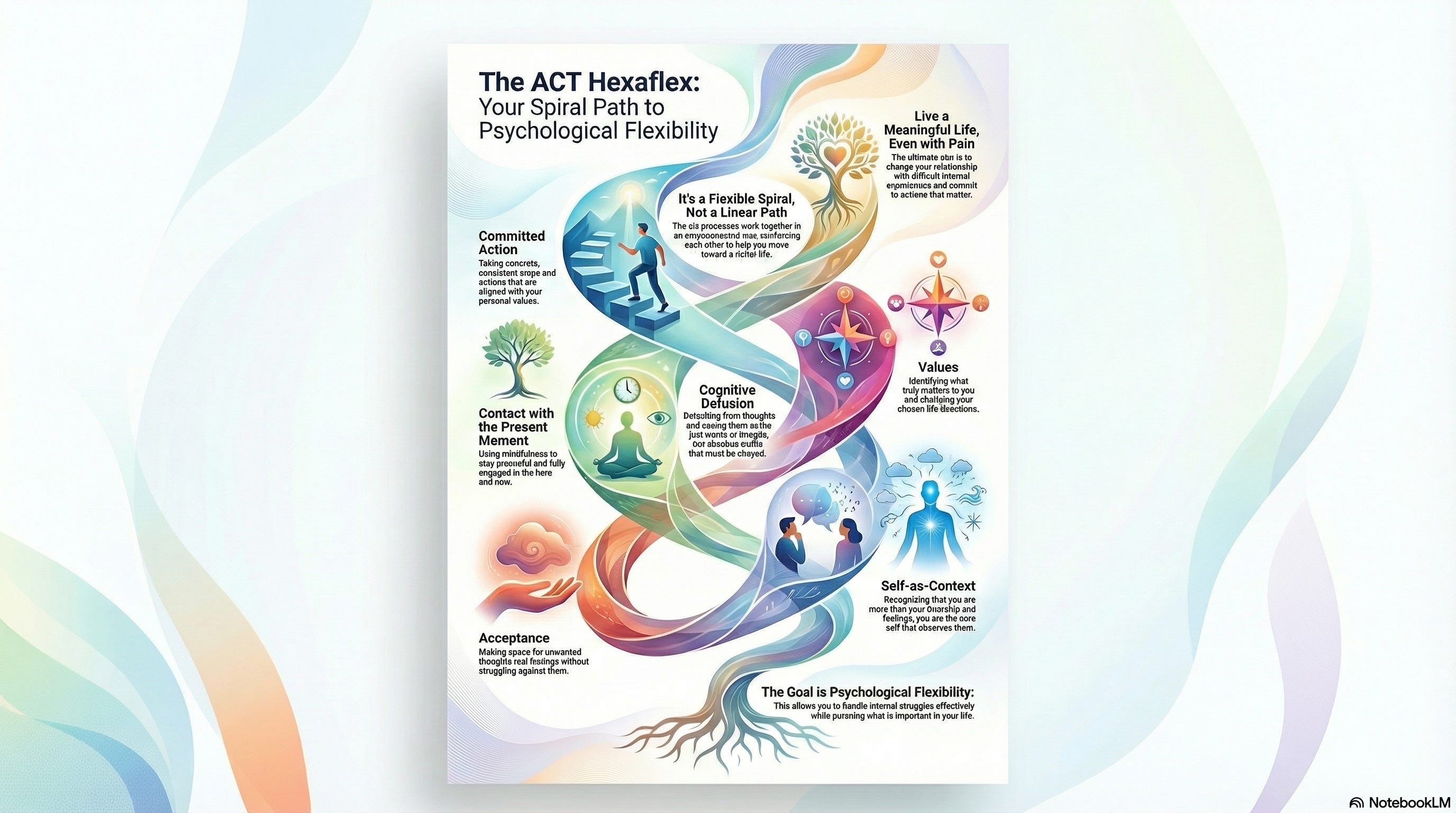
A 7-minute end-of-week reflection
Find a quiet place.
Sit or lie down comfortably.
Place one hand somewhere warm, such as the chest, belly, or throat.
Let your body arrive before your thoughts.
1. Come into the present
Look around and name five ordinary things you can see.
Not beautiful things.
Just real things.
A lamp.
A wall.
Your breath moving.
Let yourself land in now.
2. Notice what’s here
Without fixing anything, quietly ask:
What am I carrying in my body right now?
Tight? Heavy? Numb? Soft?
Where do I feel it?
Don’t analyze.
Just notice.
If words come, let them.
If they don’t, that’s okay too.
3. Unhook from the story
Write down one loud thought from this week.
The one that keeps looping.
Then gently add:
I’m noticing I’m having the thought that…
Read it again slowly.
You are not the thought.
You are the one noticing it.
4. Touch your values
Ask yourself:
What mattered to me this week?
Where did I show up honestly?
Where did I choose myself, even quietly?
Circle one word:
Care
Truth
Connection
Rest
Courage
Freedom
Gentleness
Let that word be your compass.
5. Choose micro-agency
Finish this sentence:
This week, one small act of self-trust I can take is…
Make it tiny.
So small you can’t fail.
Drink water.
Send the text.
Step outside.
Say “not today.”
6. Allow what you feel
Place your hand back on your body.
Say quietly:
I don’t have to like this moment to stay with it.
I don’t have to fix it to honor it.
Let whatever is here be here.
7. Close with intention
Finish with:
Even if I’m unsure, I am allowed to move gently forward.
I choose presence over perfection.
Take one slow breath.
Optional journal prompt
This week I was living inside ______.
What I’m learning about myself is ______.
This practice isn’t about becoming better.
It’s about becoming more here. That’s the helix. You don’t climb it once. You return to it again and again, each time a little more honest.
I am fully present in my body, embracing the sensations that guide my emotions. In moments of stress, I choose to respond with mindfulness and compassion. I let go of emotions that no longer serve me, creating space for peace and joy. My thoughts are gentle companions, leading me back to the present moment. I recognize my distractions and take steps to minimize their impact, inviting clarity into my life. I cherish the connections I cultivate, nurturing my relationships with love and authenticity. I embrace forgiveness as a powerful tool for healing and growth, allowing love to flow freely within me and towards others. I transform my fears into motivation and honor my true self, expressing my unique strengths and passions. I practice radical acceptance, align my choices with my core values, and cultivate gratitude in all that I do. I am a beacon of love, compassion, and authenticity, leaving a positive legacy as I journey through life. Today and every day, I honor my true self and the beauty I bring to the world.
Subscribe if you’re ready to make your inner room more livable.
If anything here resonates and you’re interested in working together clinically, please reach out. You can request an appointment through my secure client portal at:
https://serenity-therapy.clientsecure.me/
You may also contact me directly by email at
Cottrell.LCSW@gmail.com
Please note that this Substack is a reflective and educational space it is not therapy and does not replace a therapeutic relationship. If you’re seeking care, I’m glad to help you explore whether working together would be a good fit.